Music in Drost's Time
The instruments in Drost's paintings, the birth of the oboe, and Baroque sound from Amsterdam to Venice
Music in Drost's Amsterdam
Music was woven into daily life in the Dutch Golden Age. Amsterdam — where Drost trained in Rembrandt's workshop from 1648 — had a vibrant musical culture of public concerts and domestic music-making, and its greatest musical celebrity, Jan Pieterszoon Sweelinck, had been organist at the Oude Kerk until his death in 1621, remembered as the "Orpheus of Amsterdam." Music also saturated the art market: scenes of musicians were a staple of genre painting, sold by Rembrandt's circle to a bourgeois public who read the flute, the lute and the recorder as emblems of harmony, youthful education, or the transience of life. Four of Drost's confirmed works — Flute Player, Young Man with a Flute, Boy with a Recorder and Mercury and Argus — place an instrument at the centre of the picture.
What Was the Oboe Called in Drost's Day?
The word "oboe" did not yet exist. In Drost's lifetime (1633–1659) the instrument we now call the oboe was still being invented across the border in France: makers of the Philidor and Hotteterre families were developing the hautbois — from the French haut ("high, loud") and bois ("wood") — out of the older shawm, splitting it into three joints and eliminating the pirouette so the player's lips touched the reed directly. In English the instrument was known as the hautbois, hoboy or "French hoboy" until about 1770, when the spelling "oboe" arrived from the Italian oboè. So a contemporary of Drost would have said hautbois, or in Dutch, hobo — never yet "oboe." The instrument spread quickly: by around 1670 it began replacing the shawm in military bands, concert music and opera, and by 1700 the shawm had all but disappeared from concert life.
The Shawm Drost Knew
Before the hautbois, the loud outdoor double-reed was the shawm — the schalmei in Dutch — a conical-bore instrument turned from a single piece of wood with a flared bell and a wooden pirouette that the player pressed his lips against. Its sound was piercing and trumpet-like, suited to town bands, processions and civic ceremonies rather than the intimacy of a Dutch interior. The pipe held by the youth in Drost's Flute Player, with its end-blown posture and flared bell, belongs to this older world of pipes — while the decade in which Drost painted it, the 1650s, saw the French invention that would quietly retire the shawm from the stage.
Baroque Sound: Amsterdam to Venice
Drost's career traces the geography of the middle Baroque (c. 1630–1700). In Amsterdam, music-making ran from Sweelinck's organ legacy and Calvinist psalm singing to the chamber music of merchant households, where the recorder and the transverse flute reigned. In Italy — where Drost worked from 1655 until his death in Venice in 1659 — the age of Monteverdi had given way to the public opera houses of Venice and the concerted style of Cavalli and Legrenzi, with the new French hautbois only beginning to appear in scores. Across Europe the Baroque orchestra was taking shape around the basso continuo, and by 1700, as composers sought a more elegant sound for opera and ballet, the oboe had replaced the shawm as the leading wind voice of the ensemble.
The Oboe Today
The modern oboe is the direct descendant of Drost's era: about 65 cm of grenadilla wood with a narrow conical bore, a flared bell and a double reed of cane that most professional oboists cut and scrape themselves. Its full conservatoire system carries more than forty keys — against the three of the baroque oboe — and its range runs from B♭3 to G6. The orchestra still tunes to the A given by the first oboe, whose steady, penetrating pitch makes it the natural reference. The family has grown into the cor anglais (English horn), the oboe d'amore and the oboe da caccia, favourites of Bach and Handel, while the early-music movement performs on replicas of the three-keyed baroque instrument — so the sound that was new in Drost's Amsterdam can still be heard today.
The Instrument: Then and Now
The baroque oboe that was new in Drost's lifetime, and its direct descendant in the modern orchestra.
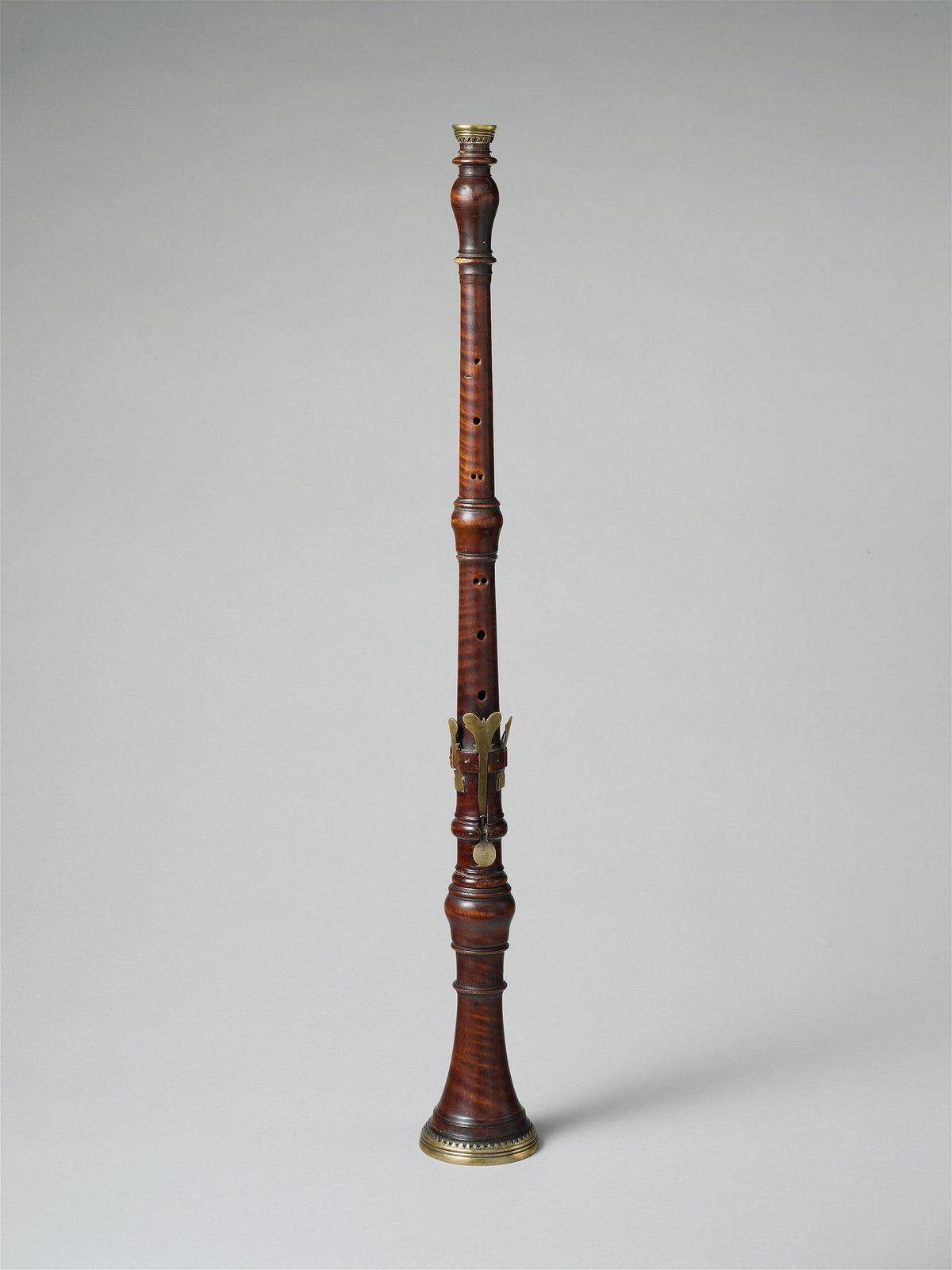
Baroque oboe (hautbois), Netherlands, c. 1700. Boxwood with ivory rings and a single brass key — the instrument that was brand new when Drost painted.
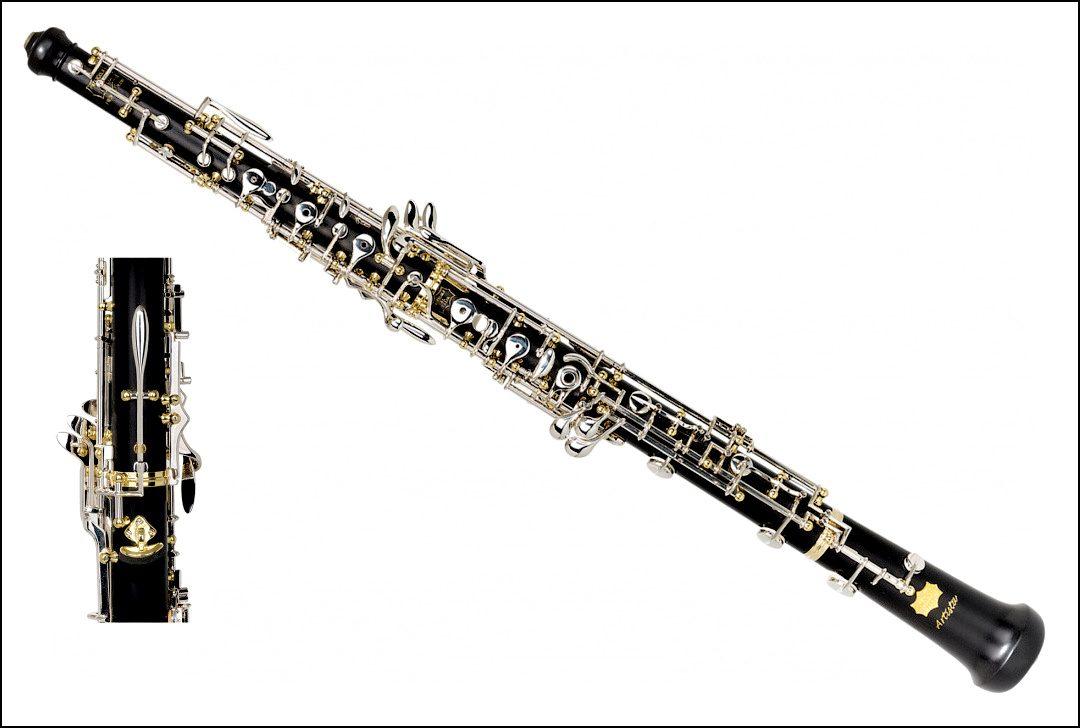
Modern conservatoire oboe, grenadilla with silver-plated keywork. More than 40 keys and a range of two and a half octaves — a world away from its three-keyed ancestor.
Related Works
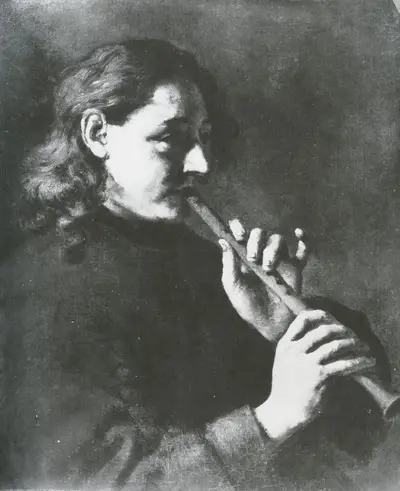
Flute Player
1655, Private Collection, Germany
A young musician playing the flute, captured in a moment of musical absorption. The painting exemplifies Drost's interest in genre subjects.
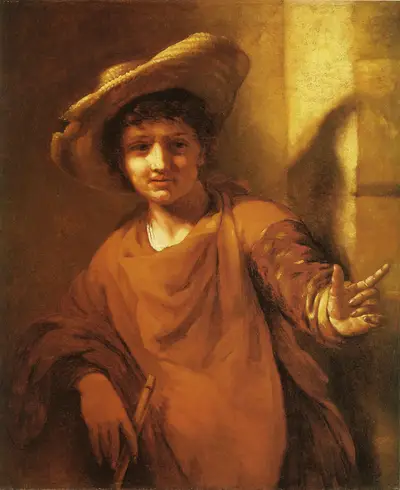
Young Man with a Flute
c. 1656, Private Collection, Scandinavia
A half-length portrait of a young man holding a flute, possibly a musician or music student. The informal composition suggests a moment of repose.
Boy with a Recorder
c. 1658, Galleria Palatina, Florence
A young boy holding a recorder, possibly a study of a musician or a genre piece depicting childhood. Painted during Drost's Italian period.
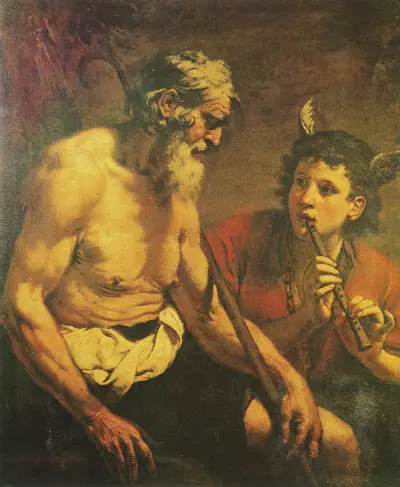
Mercury and Argus
c. 1659, Gemäldegalerie Alte Meister, Dresden
A classical mythological scene depicting Mercury lulling Argus to sleep with his flute. This is one of Drost's few known mythological subjects.
Research is ongoing. New findings are documented in our News section.