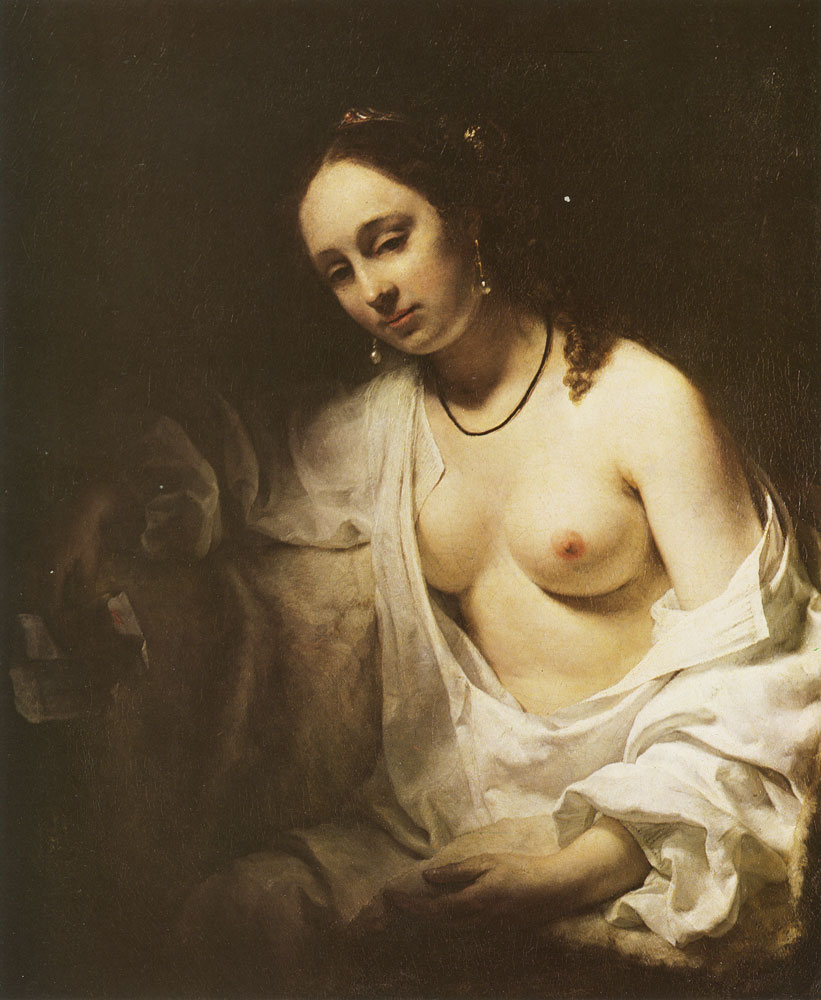
Bathsheba with King David's Letter
- Catalog
- WD-005
- Artist
- Willem Drost
- Year
- 1654
- Medium
- Oil on canvas
- Dimensions
- 103 × 87 cm
- Location
- Louvre, Paris
- Museum Location
- Richelieu wing, Salle 843
Description
Drost's most celebrated work, depicting Bathsheba holding King David's letter. The painting is remarkable for its psychological complexity and masterful handling of light and texture.
Analysis
Long attributed to Rembrandt, this monumental work is now recognized as one of Drost's greatest achievements. Bathsheba's expression conveys a mixture of emotions — surprise, contemplation, perhaps foreboding — as she reads the king's summons. The luminous flesh tones and rich fabrics showcase Drost's technical mastery at its peak. Painted in the same year as Rembrandt's own Bathsheba (also in the Louvre), Drost's version opts for a smaller canvas focused entirely on the solitary figure. Provenance: Dr Leroy d'Étiolles (1798–1860), then Comte Louis-Alfred Caroillon de Vandeul, donated to the Louvre in 1902.
Historical Context
1654 was a watershed year in Dutch art. On October 12, the Delft Thunderclap — a catastrophic gunpowder magazine explosion — killed Rembrandt's most talented former pupil, Carel Fabritius, and destroyed a quarter of Delft. Rembrandt's own Bathsheba at Her Bath was completed in the same year, creating a direct comparison with Drost's treatment. The Treaty of Westminster (April 1654) ended the First Anglo-Dutch War, and the Act of Seclusion secretly barred the House of Orange from power. In science, Christiaan Huygens was beginning his work on telescopes and pendulums. The Portuguese Jewish community of Amsterdam numbered around 3,000, and the philosopher Baruch Spinoza (aged 22) was developing the radical ideas that would lead to his excommunication in 1656. This was also the year Johannes Vermeer became a master in the Delft Guild of Saint Luke.