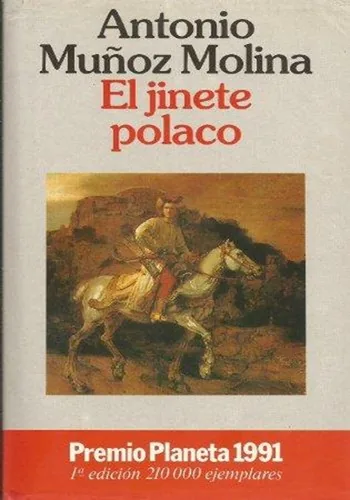
Novel
El jinete polaco
1991
This work appears on this cover
1991
This work appears on this cover
Monograph · Anthony Bailey · 1993
The only book devoted entirely to the authorship question of The Polish Rider. Bailey reconstructs the debate through the arguments and correspondence of the scholars who took sides — from the Rembrandt Research Project's hesitation to the Frick Collection's steadfastness.
Monograph · Xavier F. Salomon, with Maira Kalman · 2019
The Frick Collection's own study of its most mysterious painting, by chief curator Xavier F. Salomon. It traces the picture's journey from the Polish-Lithuanian collections of the Ogiński family to Henry Frick's acquisition in 1910, and surveys the identity theories — from Lisowczyk cavalryman to "soldier of Christ".
Monograph · Julius S. Held · 1969
Contains Held's influential essay "The 'Polish' Rider", which challenged the painting's Polish identification — arguing the costume could be Hungarian — while never doubting Rembrandt's authorship.
Article · Zdzisław Żygulski Jr. · 2000
A historian of arms and costume reopens the subject debate, defending the Lisowczyk identification — the Polish light-cavalry unit — and reviewing the attribution battles that surrounded the picture in the late 1990s.
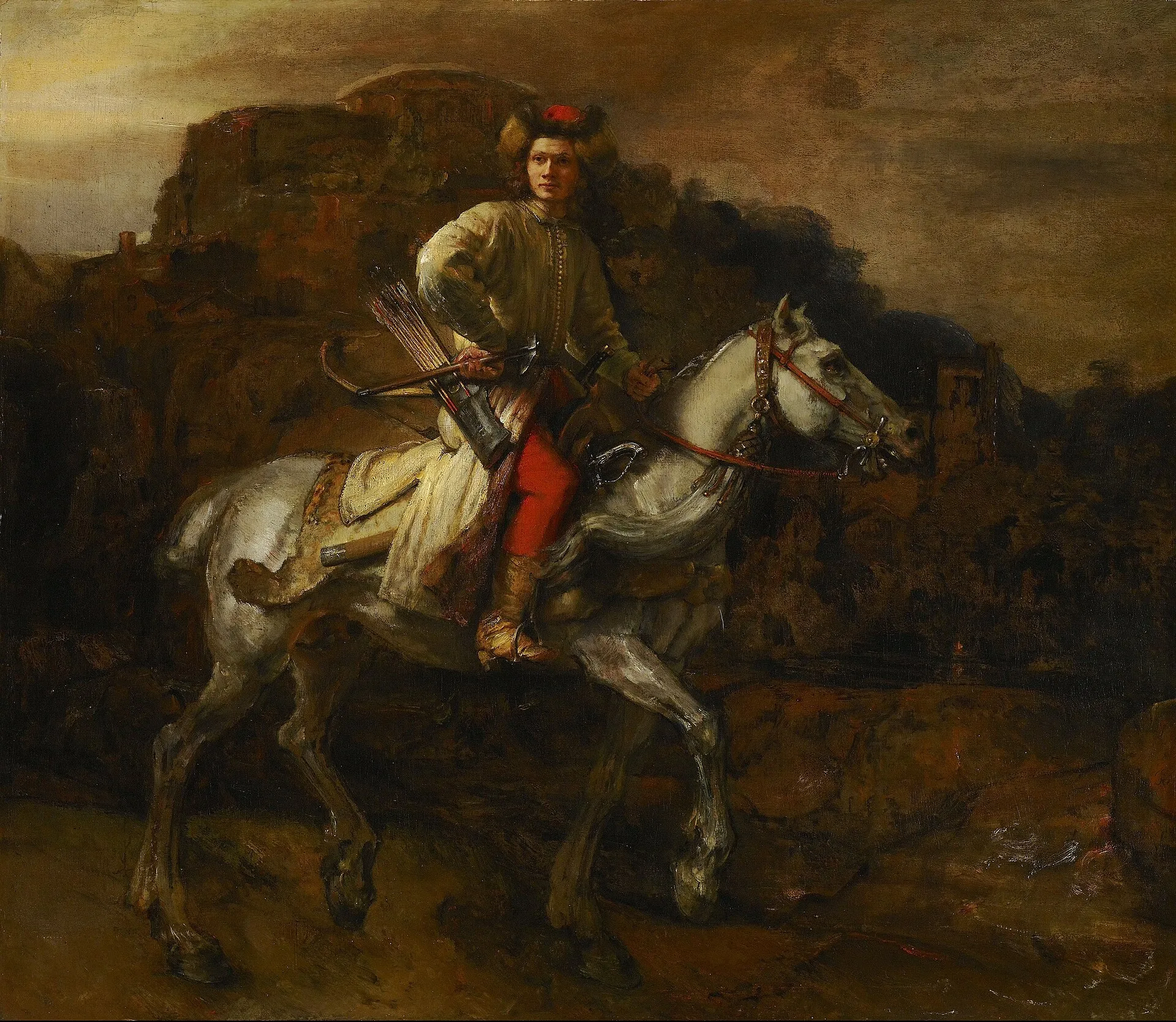
A young rider in Eastern European costume travels on a white horse through a dark, enigmatic landscape — a work of extraordinary atmosphere whose authorship has been debated for decades. Long regarded as a late masterpiece by Rembrandt, it entered the Frick Collection in 1910 under that attribution, which the museum has never changed.
The Polish Rider is one of art history's most celebrated attribution puzzles. Wilhelm von Bode (1883) and Abraham Bredius accepted it as Rembrandt's, and the consensus held until 1984, when Josua Bruyn of the Rembrandt Research Project observed that its handling of light, its type of face, and its sketchy background recalled the work of Rembrandt's pupil Willem Drost. The Drost hypothesis remained a minority view: Simon Schama (Rembrandt's Eyes, 1999) and Ernst van de Wetering defended the master's authorship, and a 1998 RRP study concluded that Rembrandt probably began the painting in the 1650s but may have left it unfinished for another hand to complete. Technical observation feeds both sides: the rider is more tightly painted than the landscape, and Rembrandt painted no other equestrian portrait before the Frederick Rihel of 1663. The Frick's label still reads simply "Rembrandt".
Painted around 1655 — the year Drost likely left Amsterdam for Italy — the picture emerged from a Europe in upheaval. The Swedish invasion of the Polish-Lithuanian Commonwealth (the "Deluge", 1655–1660) was ravaging the very country whose cavalry tradition the rider evokes; the Thirty Years' War had ended only in 1648, and the Ottoman wars on the Empire's southern frontier gave currency to the ideal of the Christian soldier — the "Miles Christi" — that some scholars see in the subject. In the Dutch Republic, Rembrandt's workshop was entering the financial crisis that would end in his 1656 bankruptcy, while Drost competed in a vibrant market for exotic character studies (tronies). The painting's later Polish provenance — the Ogiński collection, King Stanislaus Augustus, the Tarnowska family — made "Polish" part of its identity long before anyone questioned who had painted it.
1991
This work appears on this cover
Monograph · Anthony Bailey · 1993
The only book devoted entirely to the authorship question of The Polish Rider. Bailey reconstructs the debate through the arguments and correspondence of the scholars who took sides — from the Rembrandt Research Project's hesitation to the Frick Collection's steadfastness.
Monograph · Xavier F. Salomon, with Maira Kalman · 2019
The Frick Collection's own study of its most mysterious painting, by chief curator Xavier F. Salomon. It traces the picture's journey from the Polish-Lithuanian collections of the Ogiński family to Henry Frick's acquisition in 1910, and surveys the identity theories — from Lisowczyk cavalryman to "soldier of Christ".
Monograph · Julius S. Held · 1969
Contains Held's influential essay "The 'Polish' Rider", which challenged the painting's Polish identification — arguing the costume could be Hungarian — while never doubting Rembrandt's authorship.
Article · Zdzisław Żygulski Jr. · 2000
A historian of arms and costume reopens the subject debate, defending the Lisowczyk identification — the Polish light-cavalry unit — and reviewing the attribution battles that surrounded the picture in the late 1990s.